
Last updated: 2026-05-23
- Mljet is roughly 20 nautical miles from Gruž — about 1 h 15 min each way at cruising speed.
- The park’s core is two connected salt lakes and the 12th-century monastery islet of St Mary.
- Park entry is paid separately; buy tickets at Pomena or Polače.
- It only works as a full-day (8 h) or multi-day charter — a half day is not enough.
Ask our skippers for the single best full-day route out of the city and most of them say the same word: Mljet. It is the greenest island on this coast, the national park at its western end is genuinely quiet even in August, and arriving by your own boat solves the one real problem Mljet has — getting there. Here is the route we run, hour by hour, and what it costs to step ashore.
Why does Mljet need a full day?
Because the crossing takes about 75 minutes each way and the park deserves at least four hours once you arrive. Mljet lies west of the Elaphiti chain, roughly 20 nautical miles from Gruž Harbour. On our boats that is a 1 h 15 min run in normal summer conditions — a beautiful run, past Šipan and along the open channel — but it is a commitment. Squeeze it into four hours and you would spend more time travelling than swimming.
That is why we only offer Mljet on the full-day charter (8 h, from €1,200 per boat on the Fairline Phantom 40; the 17 m Malavi 55 flagship from €2,550) or as part of a multi-day itinerary. Eight hours gives you the crossing, the lakes, the monastery, a long lunch and a swim stop on the way home without anyone watching the clock.
What is the route from Gruž to Mljet?
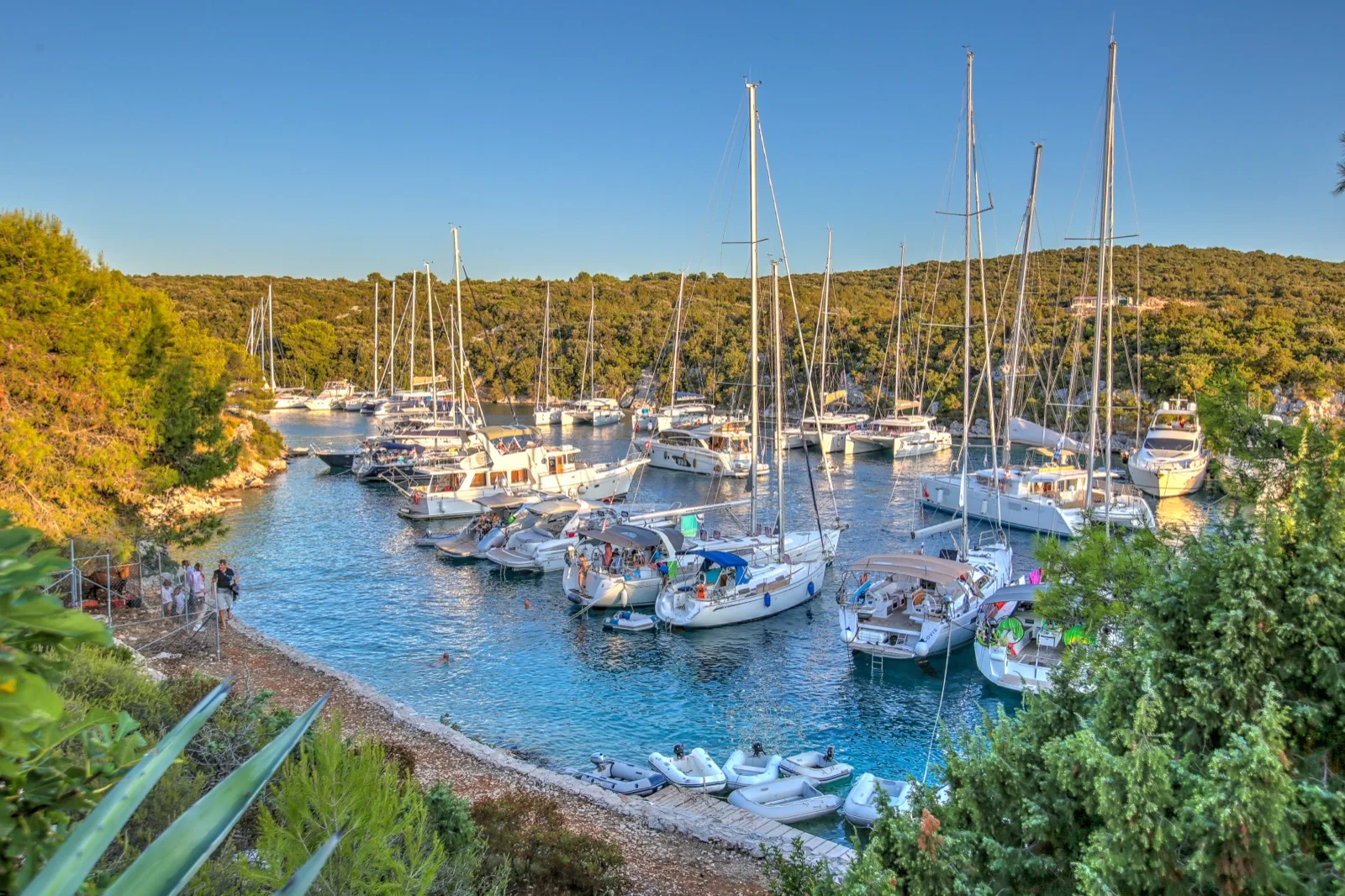
We cast off at 09:00, round the Lapad peninsula and set a west-northwest course past Koločep, Lopud and the long spine of Šipan. From Šipan’s western cape it is open water across the Mljet Channel to the island’s north coast. Depending on conditions and your preference, we enter at one of two harbours:
- Polače — a deep, sheltered bay ringed by four islets, with the ruins of a 5th-century Roman palace right on the waterfront. The safest all-weather anchorage.
- Pomena — a small harbour village at the island’s western tip, closest to the lakes (a 15-minute walk to Malo jezero).
Both are inside the park boundary. Your skipper will call the harbour choice on the day based on wind and crowding; the walk to the lakes is easy from either.
What are the two salt lakes?
Veliko jezero (“big lake”) and Malo jezero (“small lake”) are the heart of the park — two saltwater lakes connected to each other and to the open sea by narrow channels, so the water is warmer than the sea, calm as glass and an almost tropical shade of green-blue. Veliko jezero covers about 145 hectares and reaches 46 m deep; Malo jezero is smaller, shallower and the best swimming of the two, especially in June and September when the open Adriatic is still cool. The pine forest comes right down to the waterline, and a flat walking and cycling path circles both lakes.
The wider island has been protected since 1960, and the park covers the whole northwestern third of Mljet plus a 500 m belt of sea around it — one reason the water here is as clear as anywhere in Croatia. The Croatian National Tourist Board lists it among the country’s eight national parks; it is the only one on an inhabited southern island.
What is the St Mary islet?
In the middle of Veliko jezero sits Sveta Marija — a tiny islet holding a Benedictine monastery founded in the 12th century, with a Romanesque church, a walled garden and a small café in the cloister. A park boat shuttles visitors from the lakeshore to the islet, and the crossing is included in your park ticket. Allow about an hour: twenty minutes on the water, the rest wandering the monastery and its gardens. It is one of the oldest church complexes on the Adriatic islands, and the view of the lake from its bell-tower side is worth the trip alone.
How much are the park tickets?
Park entry is not included in any charter — it is a personal fee charged by the national park, not by us. In high season an adult ticket has been around €25, with lower prices in spring and autumn and reductions for children; the ticket covers the lakes area and the boat shuttle to St Mary islet. Prices and opening hours change year to year, so check the official Mljet National Park site before you travel. Tickets are sold at the entrance kiosks in Pomena and Polače, and your skipper will point you to the right window.
What does the timing look like?
Here is the schedule we actually run on a standard full-day Mljet charter:
| Time | Where | What happens |
|---|---|---|
| 09:00 | Gruž Harbour | Cast off, coffee on board |
| 10:15 | Polače or Pomena | Moor, buy park tickets |
| 10:45 | Malo jezero | First swim in the warm lake |
| 12:00 | Veliko jezero | Park boat to St Mary islet, monastery visit |
| 13:15 | Pomena or Polače | Long lunch in a waterfront konoba |
| 15:00 | Depart Mljet | Crossing back via the Mljet Channel |
| 16:00 | Šipan or Lopud | Swim stop in a quiet cove |
| 17:00 | Gruž Harbour | Home, salt-crusted and fed |
Times flex with your group — some guests skip the second swim stop and linger over lunch instead. It is a private charter; the schedule serves you, not the other way round.
Full-day or custom charter?
Take the full-day charter if Mljet is the goal and you sleep in your own bed that night. Take a custom multi-day charter if you want Mljet as one chapter of a longer story — overnight in Polače, Korčula the next day, back through the Elaphiti on day three. Either way, bring walking shoes for the lake path, cash for the konoba, and reserve your date at our booking page — August Saturdays go first, every year.
By Captain Marko Radić, who has moored in Polače more times than he can count and still orders the same grilled fish.